Medusa
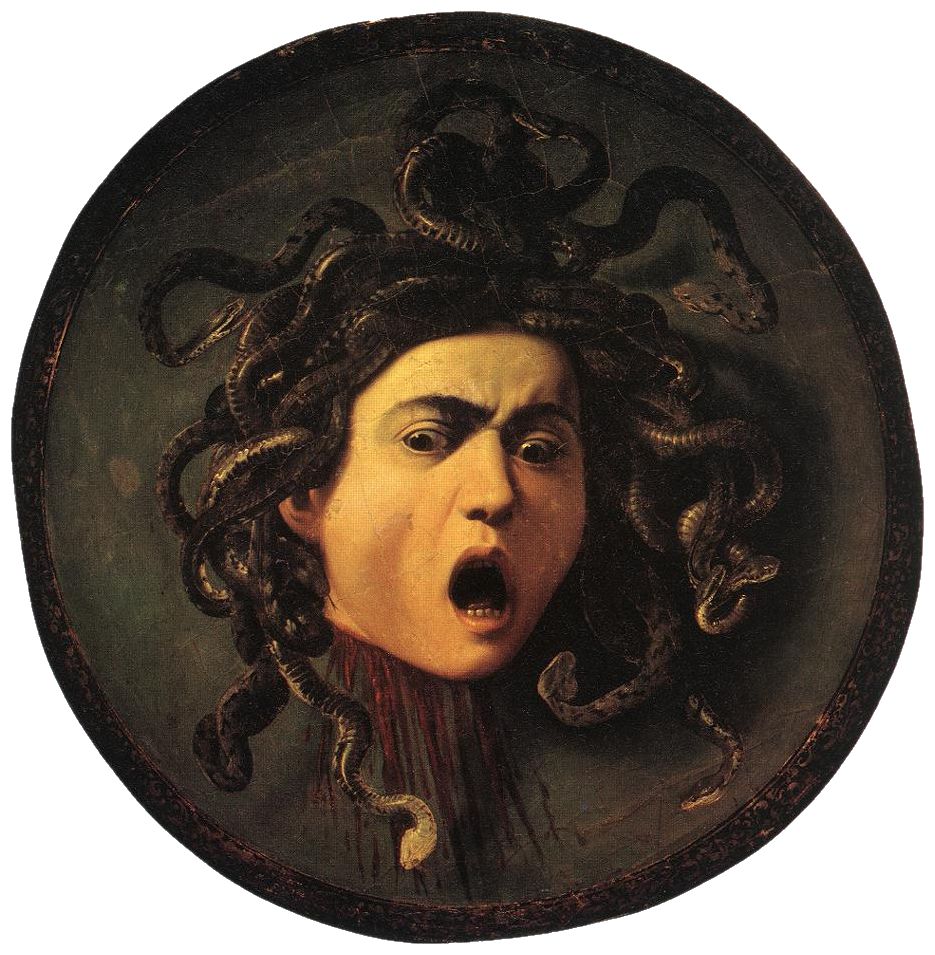
A winged Gorgon with serpents for hair whose gaze could turn any living creature to stone. Once beautiful, she was cursed by Athena and later beheaded by Perseus.
The Myth of Medusa
Medusa was originally a beautiful maiden and priestess of Athena. When Poseidon ravished her in Athena's temple, the goddess — unable to punish Poseidon — directed her fury at Medusa, transforming her beautiful hair into writhing serpents and making her face so terrible that anyone who looked upon it turned to stone.
Medusa and her two immortal sisters, Stheno and Euryale, lived at the ends of the earth. Many heroes attempted to slay Medusa, but all were turned to stone. Perseus succeeded only with divine help: Athena's reflective shield, Hermes's winged sandals, and the cap of invisibility.
Even in death, Medusa's head retained its petrifying power. Perseus used it as a weapon — turning the sea monster Cetus to stone to save Andromeda, and later petrifying Atlas and the tyrant Polydectes. He eventually gave the head to Athena, who mounted it on her aegis shield.
Parents
Phorcys and Ceto
Symbols
Fun Fact
Jellyfish of the genus Medusa are named for their resemblance to her snake-covered head.
Words We Inherited
English words and phrases that trace back to this myth. See our full guide to English words from Greek mythology.
Explore Further
Gorgons
🐉 creaturemonsters,petrification
Three winged sisters — Stheno, Euryale, and Medusa — whose faces could turn any living creature to stone. Of the three, only Medusa was mortal.
Campe
🐉 creaturemonsters
Campe was the monstrous she-dragon who guarded the Cyclopes in Tartarus — her death gave Zeus the thunderbolt that won the war against the Titans.
Ceto
🐉 creatureSea, monsters
Primordial sea goddess known as the Mother of Monsters who bore many of the most fearsome creatures in Greek myth
Echidna
🐉 creatureMother of all monsters
Echidna was half woman, half serpent — called the Mother of All Monsters for bearing the most fearsome creatures of Greek mythology.
Hydra
🐉 creatureMulti-headed serpent of Lerna
A monstrous water serpent with multiple heads that grew two more whenever one was cut off. Slaying the Hydra was Heracles's second labor.
Scylla
🐉 creaturetransformation
Beautiful nymph transformed into a six-headed sea monster by Circe's poison, eternally lurking in a strait opposite Charybdis.
Sphinx
🐉 creatureRiddling monster with a lion body and human head
A creature with the body of a lion, wings of an eagle, and head of a woman. The Sphinx terrorized Thebes with her deadly riddle until Oedipus solved it.
Lamia
🐉 creatureChild-devouring queen turned monster
Lamia was a beautiful queen of Libya whom Zeus loved; when Hera killed her children in jealousy, Lamia was driven mad and became a child-snatching monster.
Sybaris
🐉 creaturemonsters
A monstrous serpent-dragon that terrorised the region around Delphi until slain by a young hero
Ophiotaurus
🐉 creaturehybrid creatures
A creature half bull and half serpent whose entrails, if burned, could grant power to overthrow the gods
Scylla
🐉 creatureSix-headed sea monster
A terrifying sea monster with six heads on long necks, each with three rows of teeth. She lived in a cliff cave opposite the whirlpool Charybdis, creating an impossible choice for sailors.
Perseus
🗡 heroHero who slew Medusa
The son of Zeus and Danae who beheaded Medusa, rescued Andromeda, and founded the Perseid dynasty of Mycenae.