Shirt of Nessus
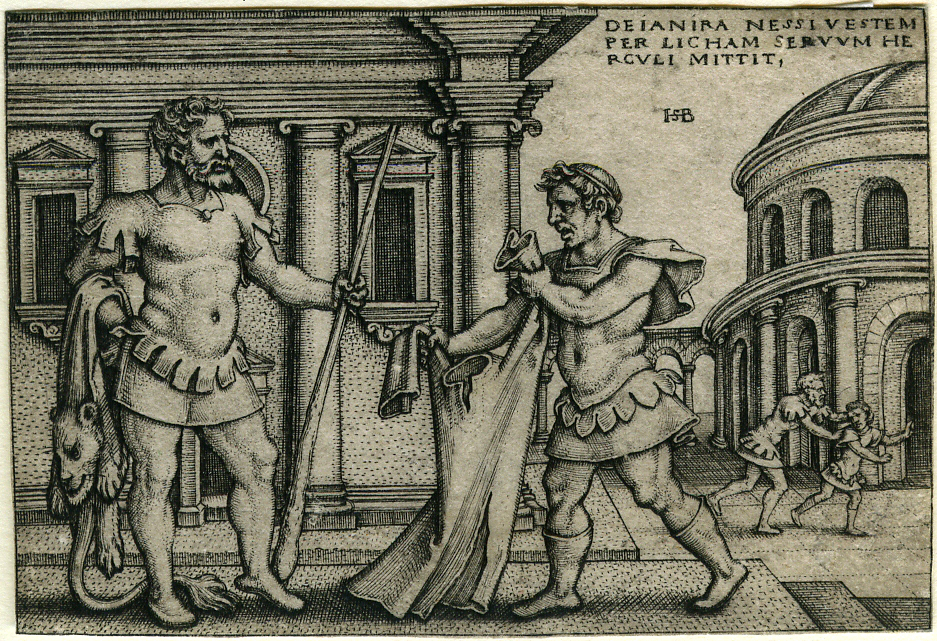
The poisoned garment that killed Heracles, soaked in the blood of the centaur Nessus and given to Deianeira as a false love charm.
The Meaning of Shirt of Nessus
The shirt of Nessus originated when the centaur Nessus attempted to assault Deianeira while carrying her across the river Evenus. Heracles shot Nessus with an arrow poisoned with the blood of the Lernaean Hydra. As Nessus lay dying, he whispered to Deianeira that his blood-soaked tunic would serve as a love charm to keep Heracles faithful. Years later, when Deianeira learned that Heracles had taken Iole as a concubine after sacking Oechalia, she sent him the shirt. When Heracles donned it for a sacrifice to Zeus at Cape Cenaeum, the Hydra's poison activated, burning his flesh. Unable to tear the garment away, Heracles built his own funeral pyre on Mount Oeta. Philoctetes lit the pyre, and Zeus raised Heracles to Olympus, where he married Hebe.
Parents
Nessus, Deianeira
Symbols
Fun Fact
The phrase "shirt of Nessus" is still used in English to describe a source of misfortune that cannot be escaped once accepted. When Mary Shelley described a ruinous obligation, she called it a "Nessus shirt." Medically, the agonising burning Heracles experienced matches descriptions of severe allergic contact dermatitis — some classicists believe the myth encodes ancient knowledge of chemical skin burns.
Words We Inherited
English words and phrases that trace back to this myth. See our full guide to English words from Greek mythology.
Explore Further
Centaur
🐉 creatureCentaur whose dying gift killed Heracles
Nessus was the centaur whose poisoned blood, given as a false love charm, ultimately destroyed the invincible Heracles.
Necklace of Harmonia
💭 conceptcurse, artifact
A cursed golden necklace crafted by Hephaestus as a wedding gift for Harmonia, bringing destruction to every subsequent owner across multiple generations.
Nessus
🐉 creatureCentaur whose blood killed Heracles
Nessus was the centaur who tried to abduct Heracles' wife Deianira — and whose poisoned blood, given as a love charm, eventually killed the greatest hero.
House of Pelops
💭 conceptDynasty, curse
The cursed royal dynasty of Mycenae descended from Pelops, encompassing the Trojan War generation
Armour of Achilles
💭 conceptArtefact
Two sets of divinely forged armour worn by the greatest Greek warrior, both crafted by Hephaestus
Cenaeum
🏛 placegeography
A promontory on the northwestern tip of Euboea where Heracles built an altar and put on the fatal shirt of Nessus.
House of Atreus
💭 conceptNarrative
The cursed royal dynasty of Mycenae whose generations of bloodshed and vengeance form the darkest saga in Greek mythology
Hippolytus and Phaedra
💭 conceptNarrative
A tragedy of forbidden desire, false accusation, and divine cruelty destroying an innocent young prince
Oedipus Cycle
💭 conceptNarrative
The interconnected myths tracing the cursed lineage of Oedipus from prophecy to tragic fulfilment
Centauromachy
💭 conceptBattle of Lapiths and Centaurs
The Centauromachy was the famous battle between the Lapiths and the Centaurs at the wedding of Pirithous — it became Greek art's favourite symbol for the clash between civilisation and barbarism.
Deianeira
🗡 herolove, destruction
The wife of Heracles whose love inadvertently killed the greatest hero in Greek mythology when she used the poisoned shirt of Nessus.
Centauromachy
💭 conceptbattle
The battle between Lapiths and Centaurs at the wedding of Pirithous when drunken centaurs tried to carry off the Lapith women.