Parthenope
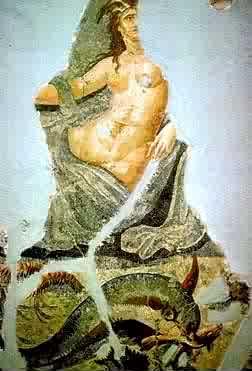
A Siren who drowned herself after failing to lure Odysseus, and whose body washed ashore where Naples now stands.
The Myth of Parthenope
Parthenope was one of the Sirens — those dangerous bird-women whose singing lured sailors to their deaths. When Odysseus sailed past their island, he plugged his crew's ears with wax and had himself lashed to the mast so he could hear their song without succumbing. The Sirens, defeated for the first time, were so devastated that they threw themselves into the sea. Parthenope's body washed ashore on the coast of Campania, in southern Italy.
The locals built a settlement around the place where she landed and named it Parthenope. As the town grew, it was eventually refounded as Neapolis — 'new city' — which became Naples. The old name persisted as an alternative: writers throughout antiquity referred to Naples as Parthenope, and Virgil, who is buried there, was called 'the Parthenopean bard.'
The Neapolitans honoured Parthenope with a cult, annual games, and a torch-race. They placed her image on their coins. A Siren who had failed at her only purpose — luring men to destruction — became the founding spirit of one of the Mediterranean's greatest cities.
Words We Inherited
English words and phrases that trace back to this myth. See our full guide to English words from Greek mythology.
Explore Further
Bolina
🌿 nymphthe sea, escape
A mortal woman pursued by Apollo who threw herself into the sea and was granted immortality as a nymph.
Halia
🌿 nymphthe sea, salt
A sea nymph of Rhodes who bore six sons and a daughter to Poseidon before throwing herself into the sea in grief.
Larissa
🌿 nymphcities, rivers
A Pelasgian nymph or princess who gave her name to the city of Larissa in Thessaly, one of Greece's oldest continuously inhabited cities.
Beroe
🌿 nymphcities, the sea
A nymph born to Aphrodite and Adonis, whose hand in marriage was contested by Poseidon and Dionysus.
Rhode
🌿 nymphthe sea, islands
A sea nymph, daughter of Poseidon and Amphitrite (or Aphrodite), who gave her name to the island of Rhodes.
Eurydice
🌿 nymphWife of Orpheus, lost to the underworld
Eurydice was the nymph whose death drove Orpheus to descend to the underworld — only to lose her at the last moment when he looked back.
Panope
🌿 nymphthe sea, visibility
A Nereid whose name means "all-seeing," invoked by sailors for clear views across open water.
Periboea
🌿 nymphthe sea, giants
A Naiad or sea nymph who bore the giant Nausithous to Poseidon, becoming the ancestress of the Phaeacians.
Ianeira
🌿 nymphEnchantment, captivating charm
Nereid sea nymph whose name means "she who enchants men," personifying the alluring fascination of the sea
Amphitrite
🌿 nymphQueen of the sea
Amphitrite was the Nereid who became queen of the sea as Poseidon's wife.
Sao
🌿 nymphSafe passage, rescue at sea
Nereid sea nymph whose name means "the rescuer," invoked by sailors for safe passage
Scylla
🌿 nymphBeautiful nymph transformed into a monster
Scylla was originally a beautiful sea nymph who was transformed into a six-headed monster by the jealous Circe or Amphitrite.