Empedocles
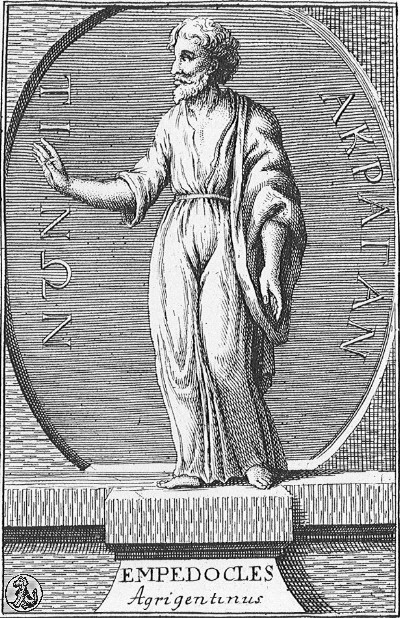
A philosopher-mystic from Akragas in Sicily who proposed the four classical elements and reportedly leapt into Mount Etna to prove his divinity.
The Legend of Empedocles
Empedocles of Akragas was a philosopher, healer, and poet of the 5th century BC who claimed divine status and dressed in purple robes with a golden crown. He taught that all matter consisted of four eternal roots: fire (associated with Zeus), air (Hera), earth (Hades), and water (Nestis/Persephone). Love (Aphrodite) and Strife (Ares/Eris) were the cosmic forces that combined and separated these elements in endless cycles. He claimed to have been a boy, a girl, a bush, a bird, and a fish in previous lives, echoing the Orphic and Pythagorean doctrine of metempsychosis. According to the most dramatic tradition, he leapt into the crater of Etna to prove he was a god — but the volcano threw back one of his bronze sandals, revealing his mortality. Diogenes Laertius records that he cured a plague and even resurrected a woman who had lain breathless for thirty days.
Parents
Meton of Akragas
Symbols
Fun Fact
Empedocles' four elements — earth, water, air, fire — dominated Western science for 2,000 years and still structure how we think. The four states of matter (solid, liquid, gas, plasma) loosely map onto them. Avatar: The Last Airbender is built entirely on his system. The periodic table replaced him, but his intuition that everything reduces to a few fundamental substances was essentially correct.
Words We Inherited
English words and phrases that trace back to this myth. See our full guide to English words from Greek mythology.
Explore Further
Asclepius
🗡 heroGod of medicine and healing
The legendary physician who could cure any illness and even raise the dead. Son of Apollo, his skill in medicine was so great that Zeus struck him down to preserve the natural order.
Phoroneus
🗡 herofire, civilization
Argive culture hero credited with discovering fire and founding the first human community.
Prometheus
🗡 heroBringer of fire and champion of humanity
Prometheus stole fire from the gods and gave it to humanity, for which Zeus chained him to a rock where an eagle devoured his liver daily — the archetypal rebel against divine authority.
Cadmus
🗡 heroFounder of Thebes who brought the alphabet to Greece
The Phoenician prince who founded Thebes, sowed dragon's teeth to raise an army, and gave Greece the gift of writing.
Heracles
🗡 heroGreatest of all Greek heroes
The son of Zeus and Alcmene who performed twelve impossible labours and was the only hero to achieve full godhood after death.
Tiresias
🗡 heroBlind prophet of Thebes
The most famous seer in Greek mythology, blinded by the gods but given the gift of prophecy in compensation. Tiresias advised kings and heroes across multiple generations.
Paris
🗡 heroPrince who caused the Trojan War
Paris was the Trojan prince whose judgement of three goddesses and abduction of Helen ignited the Trojan War — the most consequential act of desire in Western mythology.
Butes
🗡 heroBeekeeping, Resistance, Sirens
Argonaut and Athenian hero who alone leaped toward the Sirens and was saved by Aphrodite.
Podalirius
🗡 heromedicine
Son of Asclepius and Greek physician at Troy who specialized in internal medicine while his brother Machaon was the surgeon.
Pyrrha
🗡 herosurvival
Wife of Deucalion and daughter of Epimetheus who survived the great flood and helped repopulate the earth by throwing stones.
Ariadne
🗡 heroPrincess who saved Theseus from the Labyrinth
Daughter of King Minos who fell in love with Theseus and gave him the thread that allowed him to escape the Labyrinth after slaying the Minotaur.
Heracles
🗡 heroGreatest of the Greek heroes, demigod of strength
The greatest hero of Greek mythology, son of Zeus and the mortal Alcmene. Famous for his extraordinary strength and his Twelve Labors.