Trojan Horse
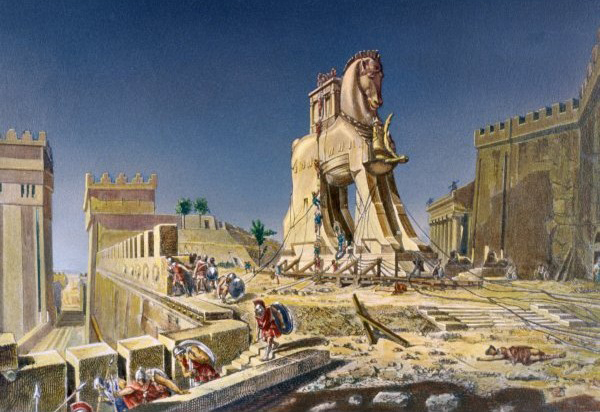
The hollow wooden horse used by the Greeks to infiltrate and destroy Troy. Devised by Odysseus, it is history's most famous act of deception.
The Meaning of Trojan Horse
After ten years of fruitless siege, Odysseus conceived the plan that would end the Trojan War. The Greeks built an enormous wooden horse and selected their best warriors — including Odysseus himself — to hide inside. The rest of the Greek army sailed away, appearing to abandon the siege.
The Trojans debated what to do with the horse. Cassandra warned it was a trap, and the priest Laocoon famously declared: "Beware of Greeks bearing gifts." But the spy Sinon convinced the Trojans that the horse was an offering to Athena, and that bringing it inside their walls would make Troy impregnable.
That night, while Troy celebrated its apparent victory, the Greek warriors emerged from the horse under cover of darkness. They opened the city gates, the Greek army returned, and Troy fell in a single night of fire and slaughter. The Trojan Horse became the defining example of deception in Western culture.
Symbols
Fun Fact
In cybersecurity, a "Trojan horse" or "Trojan" is malicious code disguised as legitimate software — digital deception inspired by the original wooden horse.
Words We Inherited
English words and phrases that trace back to this myth. See our full guide to English words from Greek mythology.
Explore Further
Trojan Horse
💭 conceptMilitary deception and computing
The wooden horse used by the Greeks to infiltrate Troy, now a universal metaphor for any deceptive strategy that conceals a hidden threat within an apparent gift
Wooden Horse
💭 conceptdeception
The hollow wooden horse built by Epeius on Athena's design that concealed Greek warriors and ended the Trojan War.
Fall of Troy
💭 conceptNarrative
The final destruction of the city of Troy through the stratagem of the wooden horse after ten years of siege
Doloneia
💭 conceptespionage
The night raid in Iliad Book 10 where Odysseus and Diomedes infiltrate the Trojan camp and slaughter the Thracian king Rhesus.
Sack of Troy
💭 conceptNarrative
The brutal destruction and plundering of Troy during the night following the wooden horse stratagem
Sinon
🗡 herodeception
Greek soldier who volunteered to stay behind at Troy and convince the Trojans to accept the wooden horse.
The Trojan War
💭 conceptWar, fate, heroism
A ten-year siege of Troy by a coalition of Greek kings, sparked by the abduction of Helen and shaped by the rivalries of the gods.
Troy
🏛 placeCity besieged in the Trojan War
The legendary city in Asia Minor besieged by the Greeks for ten years in the Trojan War. Troy's fall — achieved through the deception of the wooden horse — is one of myth's defining moments.
Bellerophon and Chimera
💭 conceptNarrative
The hero's aerial battle against a fire-breathing monster while riding the winged horse Pegasus
Seven Against Thebes
💭 conceptwar, curse
The doomed military expedition of seven champions against the seven gates of Thebes, organised by Polynices to reclaim the throne from his brother Eteocles.
Seven Against Thebes
💭 conceptNarrative
The doomed military expedition of seven champions against the city of Thebes in the generation before the Trojan War
Golden Fleece
💭 conceptThe prize sought by Jason and the Argonauts
The fleece of a golden-wooled ram, hung in a sacred grove in Colchis and guarded by a sleepless dragon. Its recovery was the object of Jason's legendary voyage.